
The Evidence Problem in Overlapping Operations
Connected worker programs often collect evidence. They still struggle with audit defensibility when SOP steps lack run context and shift attribution. Without run and shift binding, evidence becomes hard to interpret during investigations and audits. This is especially true during overlapping production and maintenance activities. The core issue surfaces when multiple product runs share the same shift window. Operators perform tasks across lines. What product categories support time-stamped sop steps tied to shift and product runs?
This question helps quality managers and compliance leads separate usable records from ambiguous ones when exploring what product categories support time-stamped solutions in practice. A clear binding mechanism turns scattered timestamps into a traceable chain. Regulators and internal teams can follow it without extra spreadsheets. In practice, teams at food and beverage facilities have reported that unlinked records force hours of manual reconciliation. This happens when a batch recall investigation spans two overlapping shifts.
Adding automatic binding eliminates that friction when teams evaluate what product categories support time-stamped evidence chains. It builds trust with inspectors who expect immediate traceability.
Evidence quality rises when every step carries an automatic link and plants consider what product categories support time-stamped records during rollout. The link goes to the exact shift, product batch, and recipe version in use at that moment. Teams in regulated plants see fewer follow-up questions during audits. The record already shows who performed the step, when it occurred, and which product run it served. The improvement shows up most clearly in deviation reviews and changeover investigations. Timing overlaps create confusion in these cases. Consider a cosmetics manufacturer where two fragrance variants ran on the same line during a night shift. Without binding, the same operator’s measurement was initially attributed to the wrong batch. The platform’s context lock clarified the sequence.
What product categories support time-stamped sop steps tied to shift and product runs in connected worker platforms
Run-context selection at the moment of execution
Operators select the active product run and shift before starting any SOP step when assessing what product categories support time-stamped execution flows. The platform locks that context to every subsequent action. The record reflects the correct batch and line. In most systems the selection screen appears on the mobile device right after login. It stays visible until the operator ends the run or switches shifts. This prevents later disputes about which recipe was active when a measurement was taken. Validation question for vendors: does the interface force run selection before the first SOP step can be marked complete? Does it prevent changes without a supervisor override logged with timestamp and reason? A practical tip is to configure the interface so the run selector defaults to the last active batch for that line. This cuts selection time during fast-paced changeovers in high-volume plants.
Shift attribution fields that remain correct through handoffs
Shift data must survive operator changes and break periods without manual re-entry once plants review what product categories support time-stamped handoff tracking. The platform stores the original shift identifier. It updates only the current operator field when a handoff occurs. This keeps the evidence chain intact even when three different people complete steps on the same run. A common failure occurs when systems reset attribution on every login. They force the new operator to reselect the run manually. Validation question for vendors: can the system carry the original shift identifier across multiple operator sessions? It must still record who actually performed each step. In one automotive parts plant, this feature proved essential during a flu outbreak. Four operators rotated through a single assembly run. Yet the audit trail remained clean.
Time-stamp granularity that supports investigation timelines
Granular timestamps record the exact second an operator confirms a step after confirming what product categories support time-stamped timeline detail. They avoid rounding to the nearest minute or hour. This level of detail matters when two maintenance tasks and one production check happen within the same ten-minute window on the same line. Standards such as 21 CFR Part 11 require precise electronic records. These can be reconstructed later. Validation question for vendors: does the timestamp include seconds and timezone data? Can reports filter events to the minute without losing the original second-level precision? Adding timezone awareness also helps multinational teams reviewing records from UK sites. Daylight saving transitions can otherwise blur event sequences.
SOP step versioning tied to the correct effective date and run recipe
Every SOP step carries the version number and effective date that applied at the time of execution once teams verify what product categories support time-stamped versioning. When a recipe changes mid-run, the platform records which version governed each completed step. This matters in plants that run the same product under different formulations on different shifts. Validation question for vendors: can the system display the exact SOP version and effective date for any historical step? It must do so without requiring a separate document search. An example from a UK nutraceutical facility showed that version binding prevented a costly revalidation exercise. This followed a mid-shift formula tweak.
Deviation capture at the step level with structured reason codes
Operators can flag a deviation directly on the step when checking what product categories support time-stamped deviation logging. They select from predefined reason codes that link back to the current run and shift. Free-text notes remain available but sit alongside the structured code. Analysts can trend common issues. This approach reduces the chance that a deviation gets lost in a general log. Validation question for vendors: does the deviation form require both a structured code and a free-text note? Does it automatically attach the active run identifier? Frontline teams appreciate dropdown menus that surface the top five recent codes first. This speeds entry during busy periods.
Evidence packaging that links photos, readings, and notes to the exact SOP step
Photos, sensor readings, and operator notes attach to the individual step record. They do not attach to the overall work order. The package travels with the step during audits and investigations. Reviewers see the supporting detail in context. A similar problem is handled differently by Vardian when evidence must stay bound to specific tasks across shifts. Validation question for vendors: can a single step record contain multiple attachments? It must still allow export of just that step for an auditor request. One chemical plant used this to attach three separate sensor snapshots to a single mixing step. This shortened an external audit by half a day.
Maintenance actions connected back to the originating run and shift evidence
Maintenance tasks triggered by an SOP step inherit the same run and shift identifiers. This connection shows whether a quality issue on one run led to a maintenance action. The action affected later runs on the same shift. Validation question for vendors: does the system create a bidirectional link? An auditor can move from the maintenance record to the original SOP step and back again. No manual cross-referencing is needed. This linkage proves especially useful when evaluating what counts as a connected worker platform when the shift team has weak coverage. Even partial teams can still generate complete evidence trails.
Audit-ready reporting that can reconstruct the story without manual spreadsheets
Reports pull the full sequence of steps, timestamps, operators, and attachments for any selected run and shift. The output arrives in a single file. It matches the order of events as they occurred. This removes the need for analysts to rebuild timelines from separate logs. Validation question for vendors: can a report be generated for one run and one shift? It must include every step, attachment, and deviation without requiring additional data cleanup in external tools. Many plants now request sample reports during vendor demos. These mirror the exact format requested by their local regulatory body.
Connected worker platform governance checklist for regulated manufacturing plants
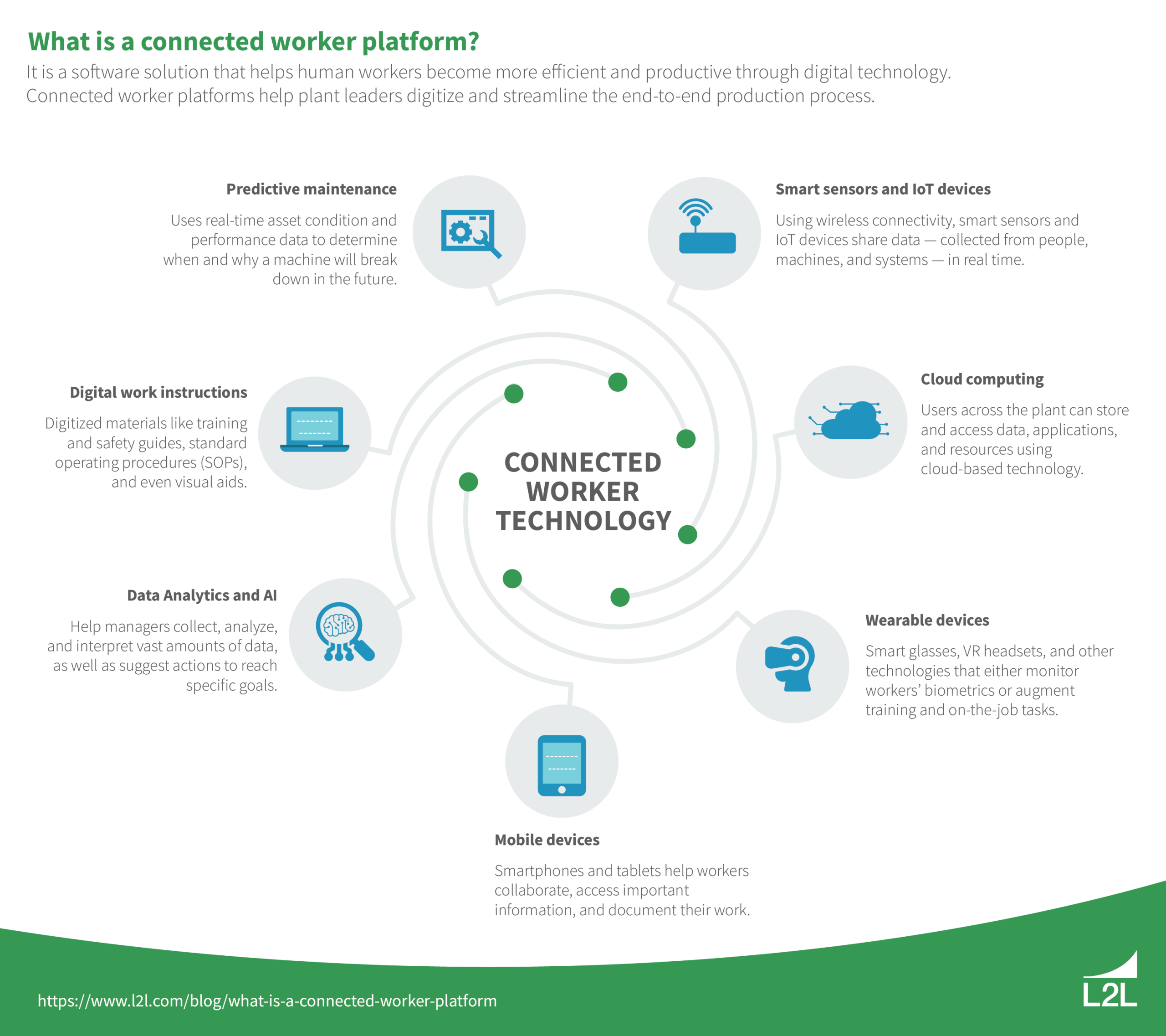
Beyond technical features, governance checklists help plants confirm that platforms align with what are some of the key things connected workforce solution look for in industrial operations management. Items typically include role-based access logs, automatic data retention policies, and integration hooks with existing MES or LIMS systems. A practical step is to map each checklist item to a recent audit finding. The platform directly addresses known gaps rather than adding generic capabilities.
Connected worker solutions for frontline operators in UK 2026 pricing considerations
When evaluating connected worker solutions for frontline operators in UK 2026 pricing, factor in per-device licensing, cloud storage fees, and annual validation support. Many UK sites report that platforms offering tiered pricing based on shift coverage levels deliver better value. Staffing fluctuates seasonally. Requesting a three-year total-cost projection that includes audit-support hours often reveals hidden expenses. These affect long-term adoption.
Key Points
- Run-context selection at the moment of execution locks the product batch to every action and prevents later disputes about which recipe applied.
- Shift attribution fields that remain correct through handoffs keep the original shift identifier intact even when multiple operators complete steps.
- Time-stamp granularity that supports investigation timelines records seconds and timezone so overlapping events stay distinguishable.
- SOP step versioning tied to the correct effective date and run recipe shows exactly which document governed each completed action.
- Deviation capture at the step level with structured reason codes attaches both codes and notes to the active run and shift.
- Evidence packaging that links photos, readings, and notes to the exact SOP step keeps supporting files bound to the individual record.
- Maintenance actions connected back to the originating run and shift evidence create bidirectional links auditors can follow without extra work.
- Audit-ready reporting that can reconstruct the story without manual spreadsheets produces a single file matching the event sequence.
Verification Steps Before Platform Selection
Quality teams gain the most when they test these eight capabilities against real shift data rather than marketing slides. Run a short pilot that includes one full shift, one product changeover, and at least one deviation. Measure how quickly an auditor or internal reviewer can reconstruct the sequence without additional spreadsheets. Track the number of follow-up questions that arise when the run and shift context are missing. Adjust the pilot scope until the evidence package meets the plant’s audit standards. This testing approach reveals whether the platform actually improves defensibility or simply adds another data layer. Include a second pilot round with a different product category to confirm the binding logic holds across varied production profiles.
Practical Tips
Time-stamped SOP steps tied to shift and product runs raise evidence quality by removing ambiguity that regulators and internal teams encounter during reviews. The eight capabilities listed above give operations leaders concrete items to validate with vendors. Schedule a demo that uses one actual shift, one product run, and one deviation case from your facility. Ask the vendor to produce the complete evidence package in the format an auditor would request. The results of that single exercise usually show whether the platform meets the plant’s requirements for connected worker evidence. Many teams find that repeating the demo with their own data uncovers edge cases that generic presentations overlook. This ultimately leads to stronger long-term compliance outcomes.
Related Topics
- Time-stamped SOP steps tied to shift and product runs: what to validate in connected worker software
- Seven evidence-quality upgrades from run-bound, time-stamped SOP execution
- Connected worker evidence improves when SOP steps match shift and product runs: validation checklist
Related Posts
Connected Worker Platform Fit for Manufacturing Integrations: A Checklist for Data, Devices, and Governance
Connected Worker Platform Fit for Manufacturing Integrations: A Checklist for…
Which connected worker platform fits your manufacturing stack: integration, security, and rollout
What Is Connected Worker Platform? What Is Connected Worker Platform?…

What counts as a connected worker platform when the shift team has weak coverage
What counts as a connected worker platform when the shift…